
What is the typical income earned for an indoor playground? The answer cannot be expressed with one sales number. If a venue produces US$16,000 in monthly revenue, that does not mean the owner earns US$16,000. Rent, payroll, utilities, marketing, cleaning, maintenance, insurance, payment fees, and product costs must be deducted first.
The three numbers that matter are the venue’s gross revenue, its operating profit after normal business expenses, and the amount the owner can finally receive through salary or profit distribution. These figures are related, but they are not interchangeable.
An indoor playground can be profitable, but the equipment does not generate profit by itself. Rent, family demand, ticket prices, attendance, party bookings, memberships, staffing, and additional spending determine the result.

1. Revenue Is Not the Same as Owner Income
Before asking how much an indoor playground makes, investors need to use the same financial definitions.
Gross Revenue
Gross revenue is the total sales generated by admissions, memberships, birthday parties, food, retail, classes, and group events. It is the amount collected before any business expense is deducted.
Gross Profit
Gross profit is revenue minus the costs directly connected to sales. Food ingredients, party supplies, payment-processing fees, grip socks, merchandise, and some hourly labor can increase as sales increase.
Operating Profit
Operating profit is what remains after deducting fixed and variable operating expenses, including rent, payroll, utilities, insurance, marketing, software, cleaning, and maintenance. It is usually more useful than revenue when evaluating whether the venue is financially healthy.
Owner Income
Owner income can include a management salary, a share of profit, or both. If the owner works as the venue manager, that salary should be included in payroll. Profit available for distribution may be reduced by loan payments, taxes, reserves, and reinvestment.
Return on Investment
ROI compares annual profit with the total initial investment. It does not compare ticket sales with the equipment quotation. A high-revenue venue can still produce a weak return when rent, payroll, or debt obligations are too high.
2. Where Indoor Playground Revenue Comes From
A stable play center should not depend only on walk-in admission. Multiple revenue channels help the venue earn throughout the week and during school holidays.
Admissions
Admissions create the most visible base revenue. Forecasts should use the average price actually paid, not the highest price on the menu. Discounts, sibling rates, group offers, free adult entry, and promotional vouchers all affect realized revenue.
Memberships and Multi-Visit Passes
Memberships generate recurring income and encourage repeat visits. Track member count, renewal rate, use frequency, and peak capacity. Frequent weekend use should not displace higher-value bookings.
Birthday Parties
A party package may combine admission, a private room, hosting, decorations, and food. Profitability depends on package revenue minus supplies, labor, cleaning, and the capacity removed from general admission.
Private Rentals and Group Events
Schools, community groups, company family days, and private rentals can fill off-peak periods. Prices must cover staffing, cleaning, materials, and exclusive venue use.
Food, Retail, and Programs
Drinks, snacks, meals, socks, toys, souvenirs, parent-child programs, and holiday activities can raise average spending per family. Sales are not pure profit: ingredients, inventory, equipment, staff, licenses, and waste must be included in the cost calculation.
3. Monthly Revenue for a 500 m² Indoor Playground
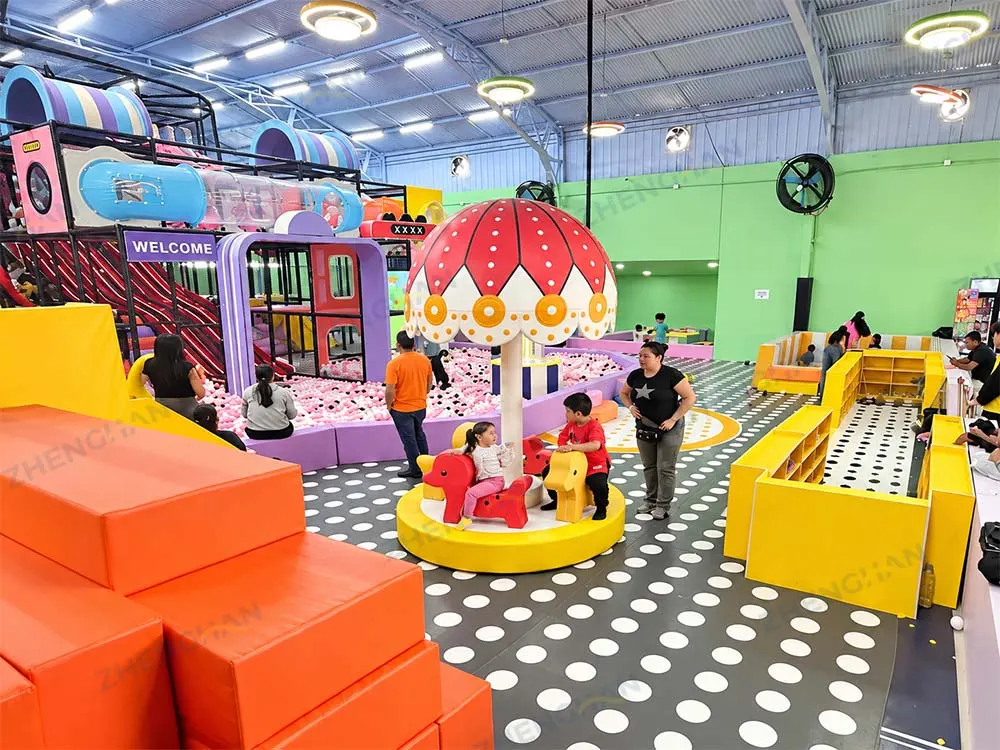
Consider a two-level commercial indoor playground with approximately 500 m² of equipment area. The figures are shown in US dollars and can be replaced with local prices, payroll, and rent for any project country.
| Revenue Channel | Example Monthly Revenue |
|---|---|
| General admission | US$8,000 |
| Birthday parties | US$3,500 |
| Memberships and multi-visit passes | US$1,500 |
| Food and retail | US$1,500 |
| Groups, classes, and additional programs | US$1,500 |
| Total Monthly Revenue | US$16,000 |
Admissions generate half of total revenue in this example. Parties, memberships, food, retail, groups, and classes generate the other half. This mix allows the same space to produce income from different products instead of relying entirely on walk-in traffic.
Revenue is not distributed evenly. Weekends, rainy days, holidays, and school breaks may be much stronger than ordinary weekdays. Forecast them separately and apply realistic seasonality.
Party revenue also depends on the number of rooms, session length, cleaning time, host availability, and the effect of parties on general-admission capacity. Membership revenue should use active members and the average fee actually collected.
4. Fixed and Variable Monthly Costs
Separating fixed and variable costs makes profit and break-even calculations easier to understand.
Fixed costs remain relatively stable in the short term even when attendance changes. They can include rent, core payroll, insurance, software, internet, accounting, management, and a base marketing allowance.
Variable and semi-variable costs rise with attendance or sales. Examples include card fees, party supplies, food ingredients, retail inventory, hourly labor, cleaning materials, utilities, and usage-related maintenance.
For the 500 m² venue, monthly fixed costs are US$6,000. Variable costs are calculated at 20% of revenue, or US$3,200 when monthly revenue reaches US$16,000.
| Cost Category | Monthly Cost |
|---|---|
| Fixed operating costs | US$6,000 |
| Variable costs at 20% of revenue | US$3,200 |
| Total Monthly Operating Cost | US$9,200 |
A 20% variable-cost ratio leaves an 80% contribution margin. That contribution first covers fixed costs; the remainder becomes operating profit.

5. How to Calculate Indoor Playground Profit Margin
| Financial Measure | Amount or Rate |
|---|---|
| Monthly revenue | US$16,000 |
| Monthly fixed costs | US$6,000 |
| Monthly variable costs | US$3,200 |
| Monthly operating profit | US$6,800 |
| Operating profit margin | 42.5% |
| Annual operating profit | US$81,600 |
Operating profit = revenue − fixed costs − variable costs.
Operating profit margin = operating profit ÷ revenue × 100%.
US$6,800 divided by US$16,000 equals 42.5%. In other words, the venue retains US$0.425 in operating profit for each US$1 of revenue after the listed operating costs.
The calculation needs a complete expense list. Leaving out owner-management salary, insurance, maintenance, marketing, or payment fees will overstate profit. If owner compensation is already included in payroll, it should not be deducted a second time.
6. How Much Can the Owner Actually Earn?
Monthly operating profit of US$6,800 is not automatically US$6,800 of personal spending money. The owner’s actual income depends on the management role, legal structure, financing, taxes, and reinvestment policy.
Owner-Managed Venue
An owner who manages scheduling, customer service, party sales, marketing, and daily operations can receive a management salary within the payroll budget. Part of the remaining profit should still support maintenance, seasonal cash flow, and future upgrades.
Manager-Operated Venue
If the business hires a full-time manager, that salary belongs in operating costs. The owner then receives income mainly through profit distributions after tax, debt payments, and required reserves.
Financing and Reinvestment
Loan principal and interest reduce monthly cash available to the owner. Equipment padding, netting, slides, activity components, and high-use parts also need inspection, repair, and replacement. Withdrawing every dollar of profit can weaken the venue’s ability to maintain quality and introduce new play value.
7. How Much Revenue Is Needed to Break Even?
The break-even point is the sales level at which revenue covers both fixed and variable costs.
Break-even sales = fixed costs ÷ contribution margin ratio.
Fixed costs are US$6,000 and the variable-cost ratio is 20%, producing an 80% contribution margin:
US$6,000 ÷ 80% = US$7,500.
The venue therefore needs approximately US$7,500 in monthly revenue to cover the costs in this example. Revenue above that amount starts contributing to operating profit.
If average spending is US$15 per paying guest and the related variable cost is US$3, each guest contributes US$12. Dividing US$6,000 of fixed costs by US$12 produces approximately 500 paying-guest equivalents per month. Party, membership, food, and group revenue also contribute, so the venue does not need to reach break-even through individual admission tickets alone.
Operators should monitor monthly revenue earned, the remaining gap to break-even, and the daily sales required during the rest of the month. This makes the break-even calculation useful for staffing, marketing, and booking decisions.
8. Calculate ROI and Payback Period
For this 500 m² two-level indoor playground, assume total initial investment is US$100,000 and stable annual operating profit is US$81,600.
Simple annual ROI = annual operating profit ÷ total initial investment × 100%.
US$81,600 ÷ US$100,000 × 100% = 81.6%.
Simple payback period = total initial investment ÷ annual operating profit × 12 months.
US$100,000 ÷ US$81,600 × 12 = approximately 14.7 months.
This simple calculation is useful for comparing project plans. A full cash-flow forecast should also include the opening ramp, seasonal demand, loan payments, taxes, equipment replacement, and future capital expenditure. A new venue may need several months to reach stable revenue, so opening working capital remains important.
9. What Determines Whether an Indoor Playground Is Profitable?
Family Demand and Location
Nearby child population, household income, parking, public transport, shopping traffic, visibility, and local competitors influence visit frequency. A busy location does not guarantee profit when rent grows faster than sales.
Weekday Attendance
A full weekend cannot solve an entire week of weak utilization. Play cafés, toddler sessions, memberships, school groups, classes, and holiday programs can improve weekday and morning use.
Party Capacity
The number of party rooms, session length, food preparation, hosts, and cleaning time determines party capacity. Party areas should support bookings without taking excessive play space or conflicting with general customer circulation.
Average Revenue per Guest
Calculate total revenue divided by paying guest visits instead of looking only at the ticket price. Memberships, parties, food, retail, and programs can improve total spending per family.
Staff Scheduling
Too few employees can harm service, cleaning, and supervision. Too many employees reduce profit. A stable core team supported by hourly staff for bookings, weekends, weather, and school holidays can provide better cost control.
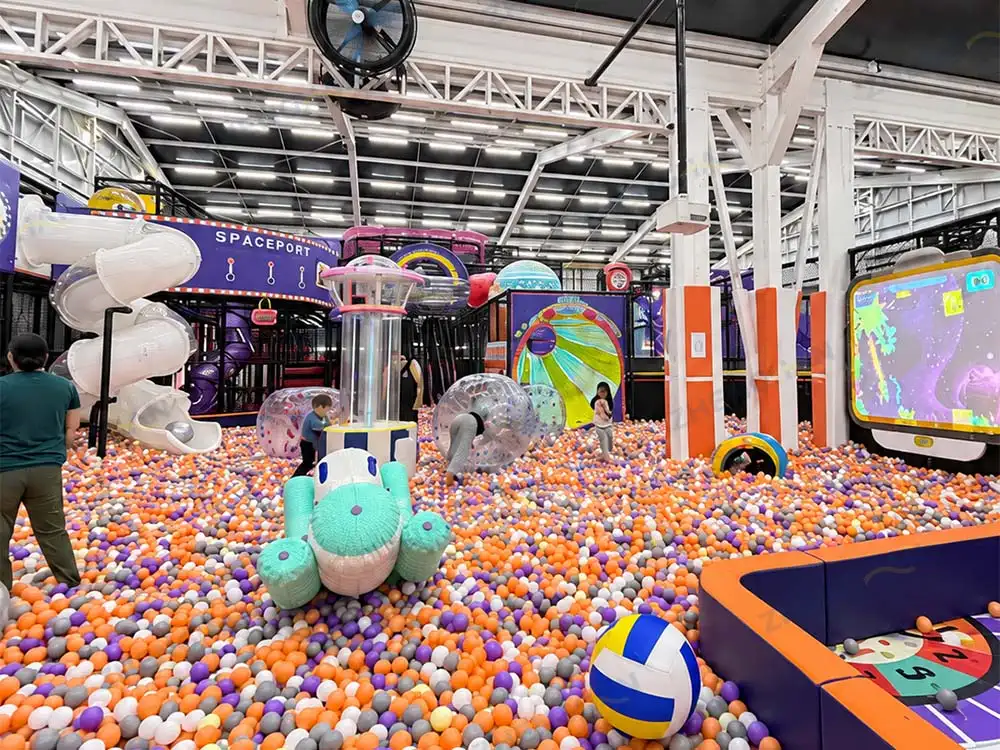
Layout and Equipment Efficiency
An indoor play structure should be designed around clear height, columns, target ages, entrances, and operating flow. Equipment, party rooms, parent seating, reception, and circulation all compete for space. An efficient layout helps the same rented area serve more customers while preserving sightlines and orderly access.
Maintenance and Downtime
A closed attraction reduces capacity and can damage customer reviews. Daily inspections, scheduled maintenance, spare-parts planning, and clear shutdown procedures help reduce unplanned downtime.
10. Project Example: HEMA PARQUE INFANTIL
HEMA PARQUE INFANTIL is located at Av. Constitución 888, 2480000 Casablanca, Valparaíso, Chile. It is an indoor play venue serving children and families.
A financial plan for this type of venue begins with its real space and operating capacity. The play structure, circulation, reception, parent area, and party space determine how many customers can be served. Local pricing and opening hours can then be combined with separate weekday, weekend, and holiday attendance forecasts.
The next step is to build different products around the same venue. Admission creates base traffic, memberships encourage repeat visits, parties and private rentals create booked revenue, and food or retail increases total spending per family. The space can earn through different products during the week instead of depending only on weekend ticket sales.
Management should track paid visits, average realized ticket price, party count, membership renewal, additional spending per guest, payroll ratio, and rent ratio every month. Combining these figures with fixed and variable costs creates a useful operating profit statement.
HEMA PARQUE INFANTIL demonstrates the role of equipment and space as the foundation of revenue capacity. Actual profit then comes from product design, customer flow, pricing, and consistent operation. Connecting the equipment layout with revenue products during planning is more effective than searching for additional income only after opening.
11. How the Manufacturer Influences Profit Potential
A manufacturer cannot guarantee profit, but equipment design affects capacity, customer experience, staff supervision, maintenance cost, and future updates.
Experienced soft play manufacturers should design around the actual building instead of copying a standard plan that does not fit the venue. Project planning should consider:
- Target ages and ability zones
- Clear height, columns, entrances, and exits
- Equipment capacity and peak-period circulation
- Staff sightlines and emergency access
- The relationship between play, parties, and parent areas
- Repeat-play value and high-demand activities
- Cleaning, inspection, and maintenance access
- Material, installation, inspection, and maintenance documents
- Spare parts, warranty, and after-sales support
More equipment is not always better. A structure that fills the building but leaves insufficient reception, queues, seating, parties, circulation, or emergency access can reduce operating efficiency. The investor, manufacturer, and local professionals should approve the final layout before production.
12. Build a Monthly Profit Plan Before Investing
Before signing a lease or ordering equipment, complete a project-specific forecast with the following inputs:
| Category | Information to Confirm |
|---|---|
| Admissions | Average realized price, weekday visits, and weekend visits |
| Memberships | Monthly fee, member count, use frequency, and renewal rate |
| Parties | Package price, monthly bookings, and direct cost per party |
| Additional sales | Food, socks, retail, classes, and group income |
| Venue | Rent, service charges, deposit, and scheduled increases |
| Payroll | Core staff, hourly staff, management, and related costs |
| Building systems | Utilities, HVAC, internet, cleaning, and waste |
| Risk and compliance | Insurance, permits, professional services, and safety management |
| Equipment | Maintenance, spare parts, replacements, and downtime reserve |
| Finance | Debt payments, taxes, working capital, and contingency |
Prepare at least a 12-month forecast. Show the opening ramp, quiet periods, school holidays, and marketing campaigns separately instead of copying one strong month across the year.
After opening, replace projections with actual figures. Variances reveal weak attendance, heavy discounting, excessive payroll, low party conversion, poor additional spending, or rent pressure.
Get Project Advice
An indoor playground financial plan should match the real building, equipment capacity, target customers, and revenue products. Share the project city, floor plan, dimensions, clear height, columns, target ages, and proposed attractions to receive practical layout and project guidance.
Send Your Floor Plan for Project Advice
Frequently Asked Questions
1. What is the typical income earned for an indoor playground?
There is no single income figure for every market. In the 500 m² two-level example, monthly revenue is US$16,000. After US$9,200 in operating costs, monthly operating profit is US$6,800. Actual results depend on local pricing, attendance, parties, memberships, rent, and payroll.
2. What is a good profit margin for an indoor playground?
Profit margin should be calculated by dividing complete operating profit by revenue. The example produces a 42.5% operating margin. Payroll, rent, insurance, maintenance, marketing, payment fees, and owner-management compensation must be included before the percentage is useful.
3. How many customers does an indoor playground need to break even?
The example requires approximately US$7,500 in monthly sales to break even. If each paying guest spends US$15 and creates US$3 of variable cost, the US$12 contribution equals approximately 500 paying-guest equivalents. Party, membership, food, and group sales also contribute.
4. Are birthday parties more profitable than admission tickets?
Birthday parties can generate higher revenue per booking, but rooms, hosts, food, decorations, cleaning, and supplies create direct costs. Compare package revenue with the direct cost and capacity used rather than comparing the package price with one admission ticket.
5. How long does an indoor playground take to recover its investment?
Payback depends on total investment and stable profit. With US$100,000 of initial investment and US$81,600 in annual operating profit, the simple payback period is approximately 14.7 months. The opening ramp, seasonality, taxes, financing, and equipment replacement affect actual cash recovery.
 English
 Spanish
 Arabic
