
How much does a trampoline cost when you are planning a commercial trampoline park? The useful answer is not the price of an individual jumping bed. Investors need to calculate the complete equipment system, international freight, import charges, installation, venue preparation, and opening capital.
A commercial trampoline park is designed around an actual building. Two venues with the same equipment area can receive different quotations because their clear heights, column positions, attraction mixes, structural requirements, delivery distances, and local project requirements are different. A price per square meter is helpful for early planning, but the final quotation must be connected to a confirmed layout and equipment list.
1. Separate the Three Levels of Trampoline Park Cost
An equipment quotation is not the complete opening budget. Evaluate a commercial project at three cost levels.
Factory Equipment Price
The factory price can include the steel frame, springs, commercial mats, padding, safety netting, platforms, entrances, drawings, packing, and selected spare parts. It normally excludes destination charges, venue work, and operating capital.
Landed Equipment Cost
Landed cost adds export packing, freight, insurance, duties, taxes, customs clearance, inland transport, unloading, and installation. It reflects the cost of delivering and assembling the system at the venue.
Total Project Investment
Total investment also includes the lease deposit, pre-opening rent, professional services, permits, venue preparation, fire and electrical adjustments, reception furniture, ticketing systems, insurance, recruitment, training, marketing, working capital, and contingency.
Total project investment = factory equipment price + freight and import costs + installation + venue work + opening capital.
Separating these levels makes quotations easier to compare and protects funds needed to prepare the venue.

2. What Is Included in Commercial Trampoline Equipment?
A commercial trampoline park is not a collection of unrelated jumping beds. It is a connected system designed for the dimensions and operating plan of the venue. A typical quotation may include:
- Main steel frames, supports, and connecting hardware
- Springs or the specified elastic connection system
- Commercial jumping mats
- Frame pads and protective padding
- Perimeter and internal safety netting
- Angled trampoline beds and padded walls
- Entrances, steps, decks, and observation platforms
- Zone and safety signage included in the order
- Layout drawings, production drawings, and installation information
- Export packing, component labels, and agreed spare parts
The quotation must match a detailed equipment list. A basketball area may contain one lane or several, while a performance area may use longer mats, deeper frames, and additional padding. Similar names do not guarantee the same configuration.
When comparing indoor commercial trampoline equipment, request a dimensioned layout, equipment schedule, material description, delivery scope, and exclusion list. This reveals whether a lower quotation comes from efficient production or simply from less equipment, smaller activity zones, or a reduced specification.
3. Commercial Trampoline Equipment Price per Square Meter
For early planning, standard commercial trampoline equipment can be estimated at US$90–US$110 per square meter of actual equipment area. This range gives investors a practical starting point before the detailed design is complete.
| Actual Equipment Area | At US$90/m² | At US$110/m² |
|---|---|---|
| 400 m² | US$36,000 | US$44,000 |
| 800 m² | US$72,000 | US$88,000 |
| 1,500 m² | US$135,000 | US$165,000 |
Basic equipment budget = actual equipment area × US$90–US$110/m².
This range is an early estimate for a conventional commercial configuration. A layout dominated by open jump areas may stay closer to the lower end. A project with more basketball lanes, performance trampolines, airbags, climbing challenges, ninja elements, or interactive systems may move toward or beyond the upper end. These features should be included in the complete layout and total quotation because their proportions and structural complexity affect the whole system.
Building area is not the same as equipment area. Reception, parent seating, party rooms, food service, storage, restrooms, offices, and required circulation all occupy floor space. Record the gross building area, customer area, and net equipment area separately. Applying the equipment rate to the entire building will overstate the equipment budget.
4. How the Complete Configuration Changes the Price
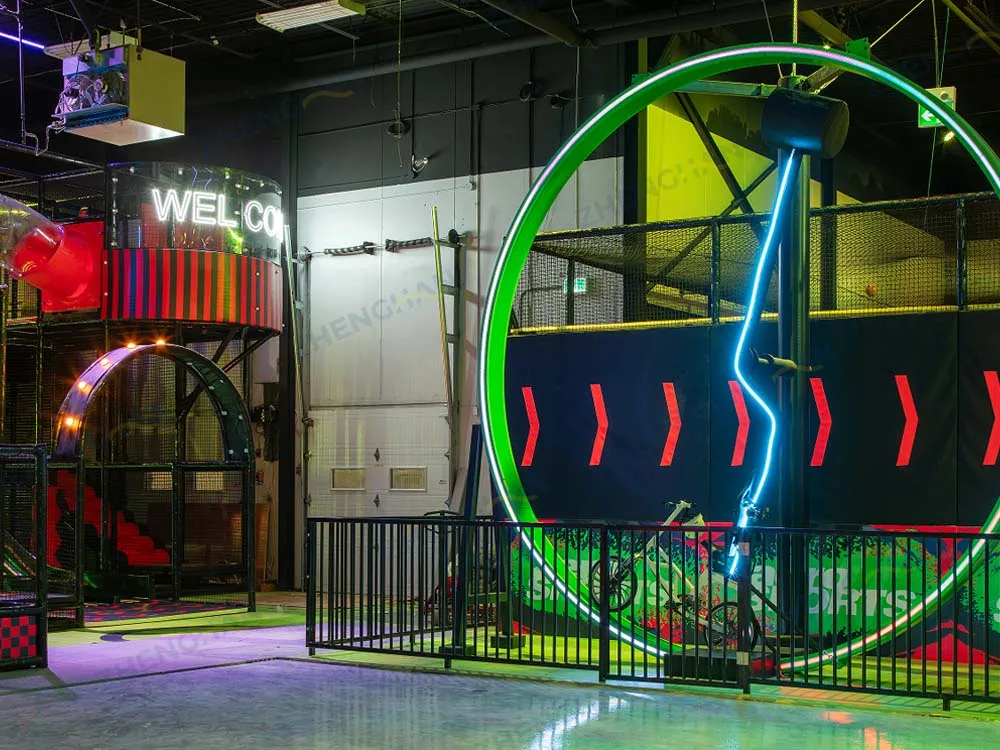
A commercial trampoline park should be designed, produced, and installed as one coordinated project. Open jump, dodgeball, basketball, performance trampolines, wall running, foam pits, and airbags are not isolated products. They share structural frames, padding, safety netting, entrances, circulation, and operating controls.
For this reason, US$90–US$110/m² should be treated as an estimate for the complete conventional trampoline system. The final price depends on layout density, material quantities, height changes, and the complexity of the full configuration—not on adding a simple price for each activity zone.
Activity Proportions Affect the Whole Material List
Open jump usually occupies the largest area and connects with basketball, dodgeball, angled beds, and other activities. More internal zones require additional padding, netting, entrances, platforms, and structural connections. These changes affect the project-wide production drawings and bill of materials.
Height and Performance Affect the Structure
Performance trampolines, wall-running areas, and elevated platforms require suitable clear height, fall protection, and surrounding clearance. The design must also coordinate with roof beams, lighting, ducts, sprinklers, and staff sightlines. A height change in one area can affect neighboring frames and protection systems.
Foam Pits and Airbags Belong in the Master Layout
A foam pit or airbag normally connects to a trampoline runway, deck, or launch platform. Its dimensions, landing area, service access, blowers, and electrical connections influence adjacent structures and installation. The complete activity flow should be established before the final quotation is issued.
Challenge Features Increase Project Complexity
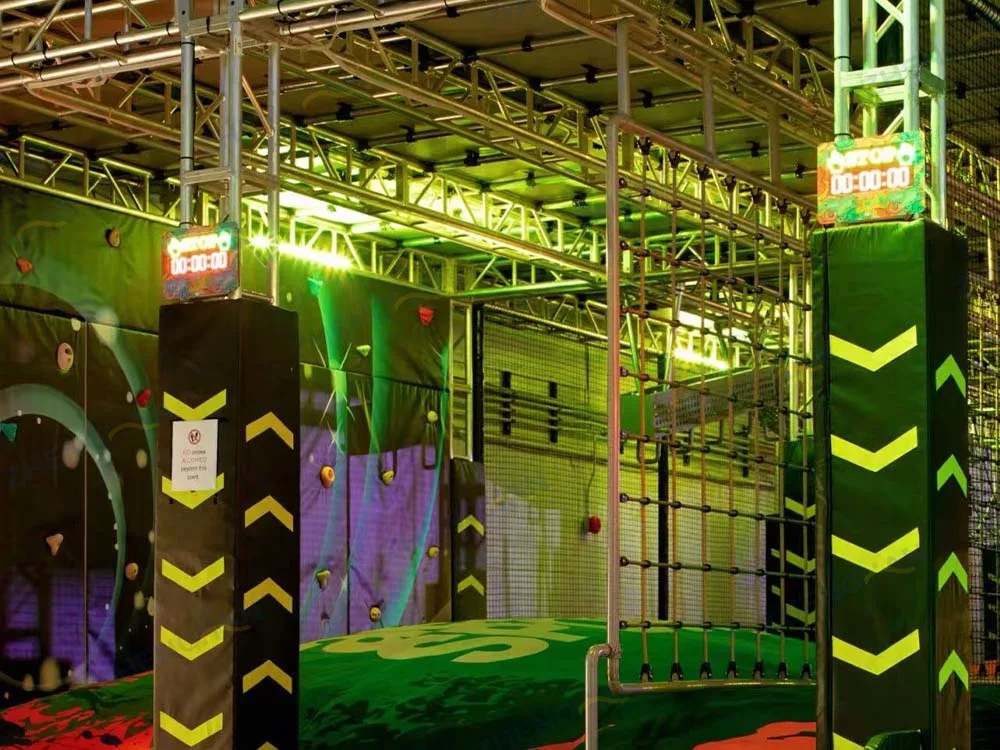
Ninja challenges, climbing elements, interactive walls, and electronic scoring can be coordinated within the master plan. Some require independent supports, power, software, or dedicated protection zones, but they must still work with the park’s circulation, capacity, staff supervision, and safety boundaries.
The manufacturer should quote from the approved floor plan. Special options may show an incremental cost, but frames, mats, springs, padding, netting, decks, and access routes must be calculated as one system.
5. How to Calculate Landed Equipment Cost
For an international purchase, the factory price is only the starting point. Build the landed-cost estimate with quotations from both the manufacturer and the freight partner.
| Cost Item | What to Confirm |
|---|---|
| Factory equipment | Final products, quantities, specifications, and trade terms |
| Export packing | Packing method, package count, volume, weight, and labels |
| International freight | Origin, destination, transport method, and seasonal changes |
| Cargo insurance | Coverage and claim documentation |
| Duties and taxes | Product classification and local calculation basis |
| Port and customs charges | Brokerage, inspections, handling, and storage risks |
| Inland delivery | Distance and vehicle requirements to the venue |
| Unloading and storage | Labor, forklift, access, and temporary storage |
| Installation | Technicians, travel, tools, accommodation, and local labor |
Shipping volume often matters more than weight. Layout changes, additional padding, longer steel members, or a different packing plan can change the container requirement. Update freight after packing data are available.
Confirm whether the supplier provides remote guidance, supervisors, or full installation, and who supplies local workers, lifting equipment, tools, travel, and accommodation.
6. Costs Outside the Equipment Contract
Equipment delivery does not make a venue ready to open. A complete budget can also include:
- Lease deposit and rent before opening
- Building surveys, concept work, and local professional services
- Permits, reviews, and inspections
- Floor, wall, lighting, HVAC, electrical, and fire-system adjustments
- Reception, lockers, seating, and party-room furniture
- Ticketing, membership, booking, access, and security systems
- Recruitment, training, uniforms, and pre-opening payroll
- Commercial insurance
- Website, signage, and opening marketing
- Cleaning supplies, grip socks, and initial operating stock
- Working capital and contingency
Venue condition is a major variable. A building previously used for retail, warehousing, or another entertainment business may have different fire, restroom, electrical, HVAC, and exit conditions. Before committing to a long lease, local professionals should review the intended use, clear height, floor conditions, fire systems, and evacuation requirements.
Building, fire, import, safety, and operating requirements differ between countries and cities. The manufacturer supplies the equipment design and relevant product documents, while local architects, engineers, consultants, and authorities confirm the rules for the project location. Keep a separate allowance for this local work.
7. Example Cost Analysis for an 800 m² Project
An 800 m² equipment area is a useful example for a medium commercial trampoline park. It can support open jump, basketball, dodgeball, an airbag, or selected challenge features while leaving room in the building for reception, parties, and parent seating.
| Budget Item | Example Amount |
|---|---|
| Commercial trampoline equipment at US$100/m² | US$80,000 |
| Lease deposit and pre-opening rent | US$4,000 |
| Design, consultants, and permits | US$2,000 |
| Venue work and building-system adjustments | US$10,000 |
| International freight, import, and inland transport | US$12,000 |
| Unloading and installation | US$5,000 |
| Reception, furniture, ticketing, and operating systems | US$3,000 |
| Recruitment, training, marketing, and working capital | US$6,000 |
| Project contingency | US$3,000 |
| Example Total Investment | US$125,000 |
In this example, equipment represents US$80,000, while other delivery and opening costs total US$45,000. The table shows why multiplying area by an equipment rate is only the first step. Rent, local work, freight, installation, and opening capital still need to be included. Replace every line with quotations for the actual venue before making an investment decision.
8. Why Supplier Quotations Can Be Very Different
Two layouts can look similar while carrying different prices. When comparing park equipment manufacturers, review the following points.
Is the Equipment Area Measured the Same Way?
One quotation may use gross building area while another uses only the equipment footprint. Check whether circulation, platforms, irregular corners, and support spaces are included.
Are the Functions and Specifications Equivalent?
Compare jumping beds, basketball lanes, performance mats, airbag dimensions, deck heights, and interactive features. Area alone cannot show whether two offers are equivalent.
Are Materials and Documents Defined?
The quotation should identify frame, mat, spring, padding, netting, and connection specifications, plus the included drawings, product information, manuals, and spare-parts list.
Do Delivery Terms Match?
Factory collection, FOB, CIF, venue delivery, and full installation have different scopes. Compare offers at the same delivery boundary, then confirm warranty, wear parts, lead times, and after-sales service.
9. Control Cost Without Reducing Safety
Cost control should come from planning, not from removing necessary structure, protection, or documentation.
- Protect the core experience. Build the initial plan around the activities that serve the target age group and operating model.
- Design from accurate building information. Provide dimensions, clear heights, columns, exits, sprinklers, ducts, and electrical points before layout work begins.
- Use complex features deliberately. Performance zones, airbags, climbing, ninja, and interactive features should support a defined customer or program.
- Freeze the layout before production. Late changes to areas, colors, entrances, or attractions can affect materials, packing, timing, and installation.
- Prepare an initial spare-parts stock. Keep suitable mats, springs, pad covers, net connections, and other maintenance items available.
- Maintain a project contingency. Freight, site conditions, and local reviews can change. A contingency protects required safety and operating items from budget cuts.
10. Project Example: Aerosports Parks – Scarborough/Toronto
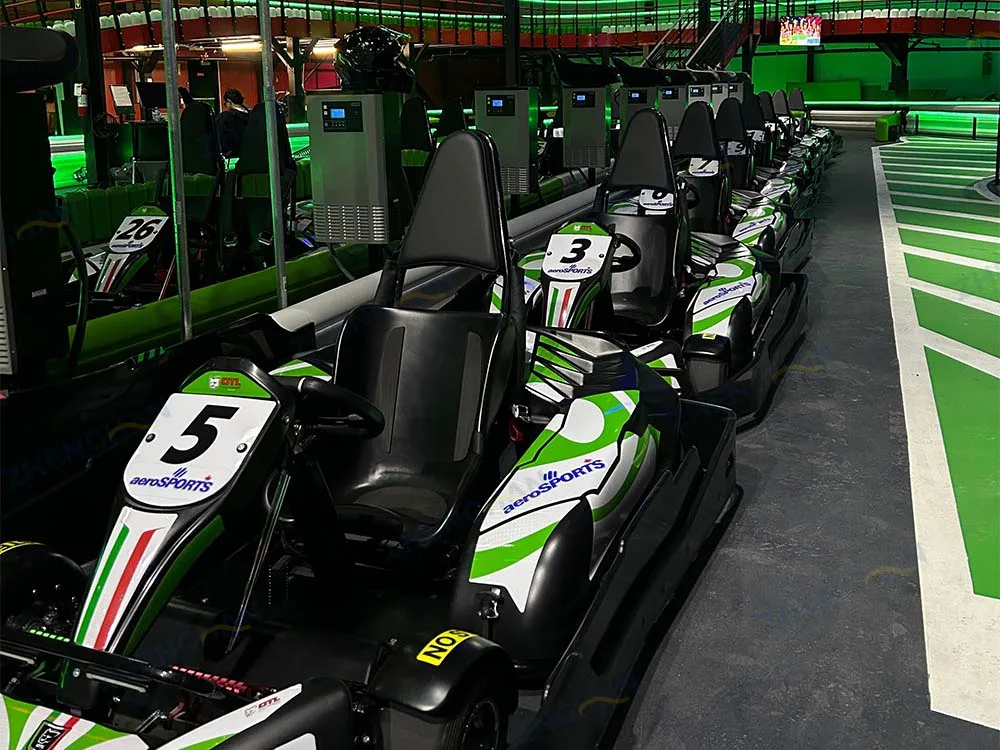
Aerosports Parks – Scarborough/Toronto is located at 1120 Birchmount Rd, Scarborough, ON M1K 5G4, Canada. The venue has more than 50,000 square feet of indoor entertainment space and combines freestyle jump, dodgeball, basketball, ninja activities, go-karts, laser tag, mini golf, climbing, and interactive sports.
This type of large entertainment center requires two connected budgeting views. The trampoline park itself must be designed and quoted as one coordinated system. Separate attraction categories outside that system—such as go-karts, laser tag, and mini golf—also need their own equipment, freight, installation, utilities, and operating allowances before they are combined into the full venue budget.
A master layout should coordinate all attraction categories with reception, queues, party areas, seating, customer circulation, staff sightlines, power, HVAC, fire systems, exits, and service access. This prevents the project from using one trampoline rate to estimate facilities that have completely different structures and operating requirements.
11. Information Required for an Accurate Quotation
A manufacturer needs real venue information before preparing a useful layout and price. Submit:
- Project country and city
- A dimensioned CAD drawing or accurate measurement plan
- Total length, width, and clear height by area
- Columns, walls, entrances, exits, and fire routes
- Sprinklers, ducts, lights, and other overhead obstructions
- Actual area intended for equipment
- Target age groups and expected operating capacity
- Required activities and their priorities
- Preferred opening date
- Expected shipping and installation method
Review the first layout, then request the final equipment list, delivery scope, packing data, production schedule, and payment milestones. A quotation tied to the approved design produces a more reliable budget.
12. Questions to Ask Before Placing an Order
- What net equipment area is used in the quotation?
- What are the dimensions and specifications of each activity area?
- Which frames, mats, springs, pads, nets, platforms, and entrances are included?
- Which drawings, product documents, and manuals are supplied?
- What are the packing volume, weight, and estimated container requirements?
- Which trade term applies, and which destination charges are excluded?
- Who performs the installation and supplies local workers and tools?
- What are the production, shipping, and installation schedules?
- What does the warranty cover?
- How are wear parts and replacement components ordered?
A useful commercial quotation should show what the investor is buying, what remains outside the supplier’s scope, and how the equipment fits the actual building. A total price without a layout, equipment schedule, and delivery boundary is not sufficient for an investment decision.
Get a Project Budget
A reliable trampoline park budget starts with the real building and the complete attraction plan. Send the floor plan, dimensions, clear heights, columns, target ages, and required activities to receive layout and cost guidance for your project.
Send Your Floor Plan for Project Advice
Frequently Asked Questions
1. How much does a commercial trampoline park cost?
Total investment depends on equipment area, configuration, venue work, freight, import costs, installation, and local operating expenses. In the 800 m² example in this guide, equipment costs about US$80,000 and total project investment is approximately US$125,000. An actual budget should be prepared from the venue and approved layout.
2. How much does trampoline park equipment cost per square meter?
Standard commercial trampoline equipment can be estimated at US$90–US$110/m² for early planning. A simple open-jump configuration may stay near the lower end, while a system with performance trampolines, airbags, ninja, climbing, or interactive features can cost more. Final pricing should follow the approved floor plan and equipment list.
3. Does the equipment price include shipping and installation?
Not automatically. A factory price, an ocean-freight quotation, delivery to the venue, and a fully installed price have different scopes. The contract should state who pays for packing, freight, duties, customs clearance, inland delivery, unloading, technicians, local labor, tools, travel, and accommodation.
4. Which configurations increase the trampoline park price?
Performance trampolines, wall-running areas, elevated decks, large airbags, complex height changes, and features requiring independent supports or electronic systems can increase the overall project price. Their effect depends on size, quantity, layout, structure, and protection requirements.
5. What information is required for an accurate quotation?
Provide the project location, dimensioned floor plan, clear heights, columns, entrances, exits, overhead obstructions, actual equipment area, target ages, expected capacity, complete activity list, preferred delivery method, and opening schedule. Complete information produces a more reliable layout, packing plan, and installation estimate.
 English
 Spanish
 Arabic
