
Choosing your trampoline park features is a important thing that you must balance your upfront budget against your daily maintenance labor. Get it right, and the park runs itself; get it wrong, and you will bleed money on constant repairs. Here is my unvarnished, factory-level breakdown of the attractions you absolutely need, the exact materials we use to build them, and how you should run them on a busy Saturday. Ten years in this manufacturing business taught me one simple truth: investors overthink it. Once you secure a warehouse to build an indoor park, you might suddenly find yourself looking at million-dollar tech gadgets to outsmart the competition—but you need to stop. Let me give you some advice straight from my factory floor: you don’t need gimmicks, you just need sheer durability.
Kids will test your equipment to its absolute limits, and if it can break, they will break it. As seasoned play park equipment suppliers, we build parks that survive this daily abuse. Your flat jumping mats and your heavy-duty commercial trampolines are simply the concrete foundation of your business. To actually make a profit and keep families coming back every weekend, you need to add the right attractions.
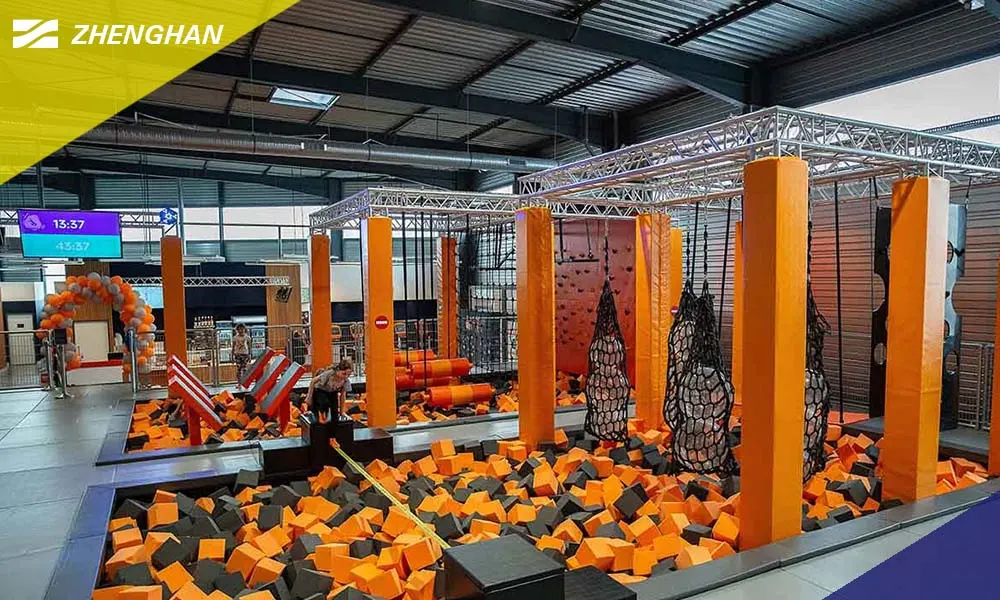
1. The Ninja Warrior Course: Built on Solid Steel
If you want to pull in the 14-to-18-year-old crowd—the demographic that actually buys expensive food from your concession stand—you need a Ninja Course because it is physical, highly competitive, and keeps teenagers in your building for hours.
The Backbone: Heavy-Duty Galvanized Steel
Let’s talk framing. There is a lot of noise online about what metal to use, but you should ignore it and focus on practicality. We frame our ninja courses using heavy-duty galvanized steel pipes because it is the global industry standard that gives you massive structural strength without destroying your startup budget.
With dozens of teenagers swinging, jumping, and hanging on this frame at the exact same time, the dynamic load is huge, but galvanized steel handles it perfectly. To stop sweat and indoor humidity from rusting the metal, we run every single pipe through a strict high-temperature powder-coating process that bakes a protective layer right onto the metal. This completely seals out moisture, ensuring your structure stays safe and looks brand new without wasting your capital on unnecessary exotic materials.
The Ceiling Height Reality Check
Do not sign a commercial lease until you carefully measure your clear vertical space. I have seen guys rent a building with low ceilings to save money, only to act completely surprised when tall kids hit their heads on the monkey bars. You need a clear ceiling height of 5.5 meters—and I mean 5.5 meters below your lighting fixtures, your fire sprinklers, and your AC ducts. Send your building blueprints to our engineering team before you finalize anything so we can adjust the layout before the steel is cut, rather than fighting your building’s geometry onsite.
2. Climbing Walls: The Double Safety Guarantee
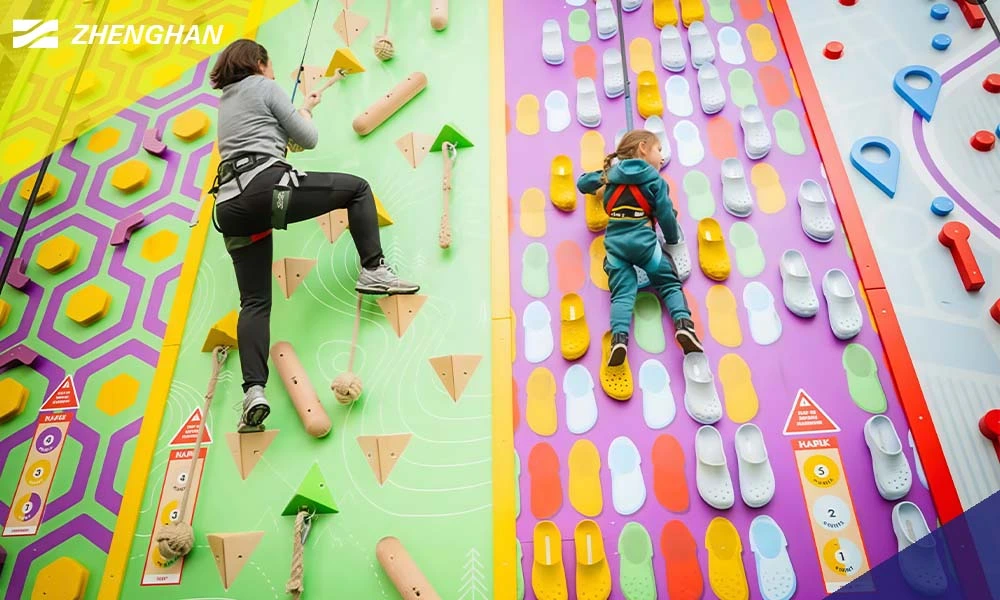
Parents are naturally terrified of heights, and if a mom walks into your park and thinks your climbing wall looks dangerous, she will turn around and walk out. You absolutely must utilize vertical space to maximize your floor plan, but you cannot compromise on safety.
Harnesses Plus Buffer Pads
We do not take chances, which is why we enforce a strict “Double Safety Guarantee” for all our commercial climbing installations by combining two completely different safety systems. First, every player wears a secure safety harness attached to a reliable belay rope, and second, we position the entire climbing wall directly over a soft landing zone—either a deep foam pit or a custom safety airbag.
Think about the psychology here. If a kid gets tired and loses their grip, the harness system controls their descent while the soft buffer pad below provides a massive, visible secondary layer of protection. Parents see the harness, they see the thick pad, and they relax, which eliminates both the risk of hard falls and your liability anxiety as an owner.
Board and Grip Construction
A climbing wall is entirely worthless if the holds spin. We manufacture the backing panels using solid multi-plywood or heavy fiberglass, and then we attach heavy-duty resin climbing holds that are bolted directly into heavy steel anchors mounted behind the board. A 200-pound man can pull on these holds a thousand times, and they will never crack, spin, or loosen.
3. The Mechanical Wipeout Sweeper: Practical Crowd Control
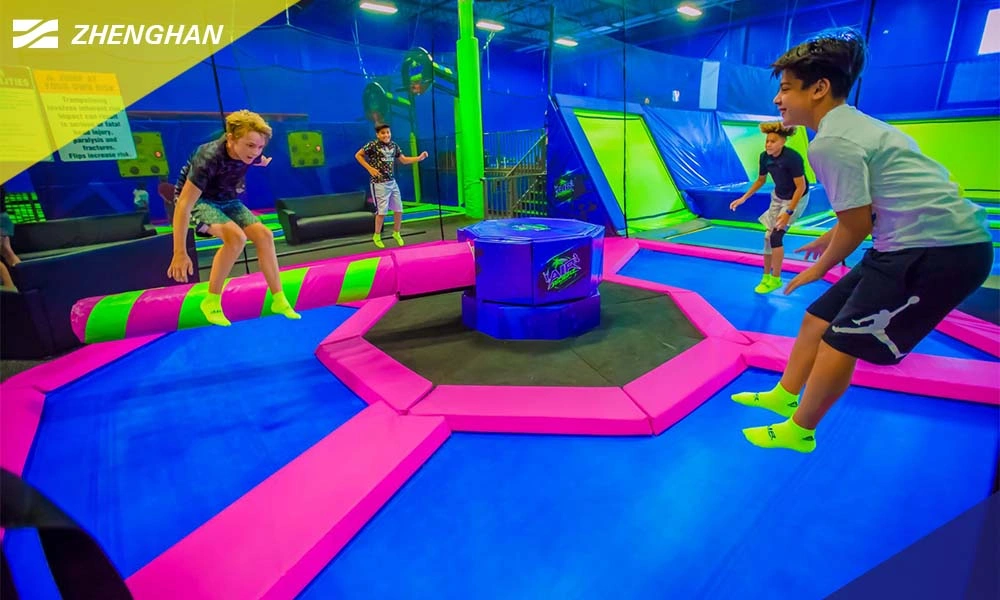
Saturday afternoons are chaotic with hundreds of kids running around, so you need features that can absorb a lot of players at once. An eight-player Wipeout machine is your best crowd controller because it takes eight kids off the main jump floor for five solid minutes at a time.
Standard Motors and Staff Supervision
Investors always ask me about the motors burning out, and the reality is that kids will inevitably try to sit on the spinning arm or wrestle it to the ground. If you just leave the machine running unattended, that extreme physical resistance will eventually burn out any motor.
The most practical, cost-effective fix is a heavy-duty standard motor paired with smart staff operations. We give you a dedicated control box with a speed adjustment dial and a big emergency stop button, and you must station an attendant right there. If that attendant sees three kids pile onto the sweeping arm, they hit the E-stop to halt the machine, ask the kids to step off, and simply restart the game. This simple human intervention protects your hardware so that motor can run for years.
Industrial-Grade Wrapping
Because that sweeping arm takes a daily beating, we wrap the inner steel core in thick, shock-absorbing EVA foam and cover the whole thing in heavy-duty Plato PVC with double-stitched seams. Grip socks create a massive amount of friction, but this robust PVC setup takes the abuse so you don’t have to constantly order replacement pads.
4. The Landing Zones: Foam Pits vs. Airbags
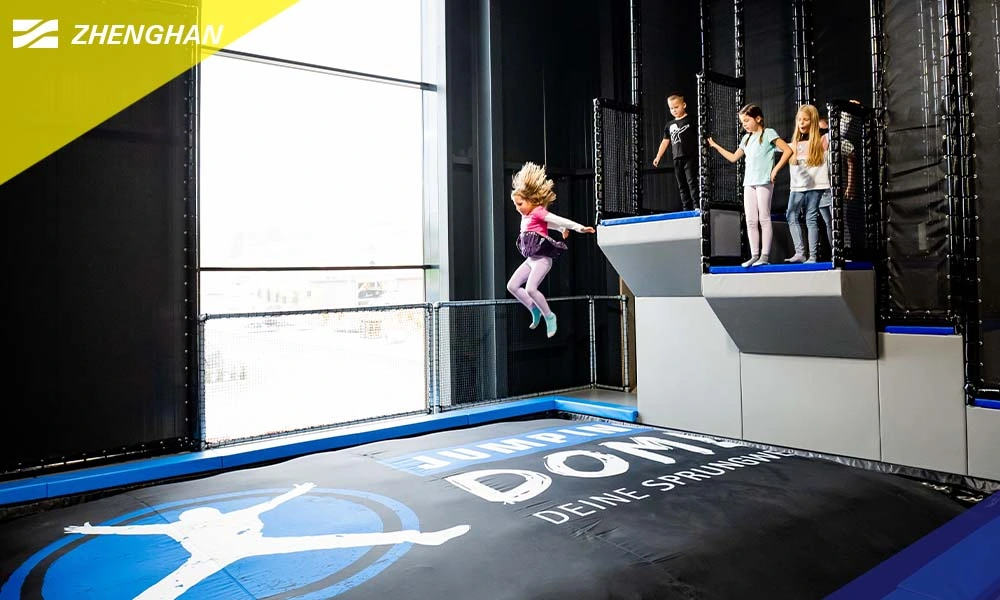
Every jump tower and stunt zone needs a place for kids to land safely, and you have two excellent choices depending entirely on how much you want to spend upfront versus how much you want to pay your cleaning staff later.
The Classic Foam Pit
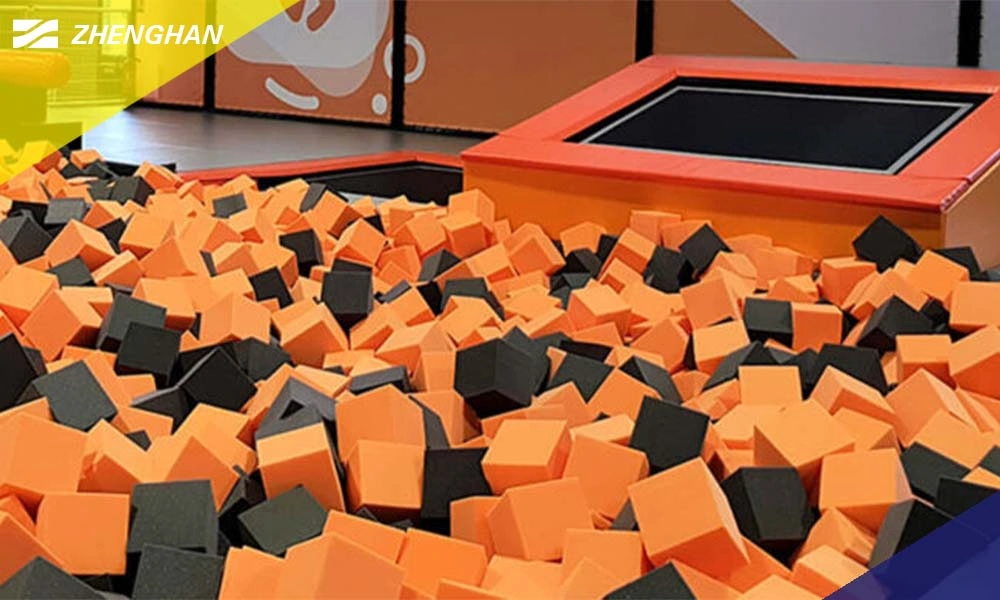
Foam pits are the classic choice because the upfront cost to buy the polyurethane foam cubes is very reasonable, and kids absolutely love diving into them.
If you go with a foam pit, you just have to accept that kids sweat, friction creates dust, and once a week your staff must pull the foam blocks out to vacuum the bottom of the pit. As long as they throw away any blocks that are torn in half and keep the pit clean, this will serve you perfectly as a solid, budget-friendly setup.
The Safety Airbag Upgrade
If you have the capital and hate doing weekly maintenance, you should buy an inflatable safety airbag that uses electric blowers to stay pressurized while the top sheet catches the jumper softly. The massive advantage here is labor savings: at closing time, your staff does not have to pull out hundreds of foam blocks; they simply take a sanitizer mop, wipe the smooth PVC top sheet clean in three minutes, and turn off the power. Low upfront cost versus low daily labor—pick the one that fits your business model.
5. Dodgeball and Basketball Zones
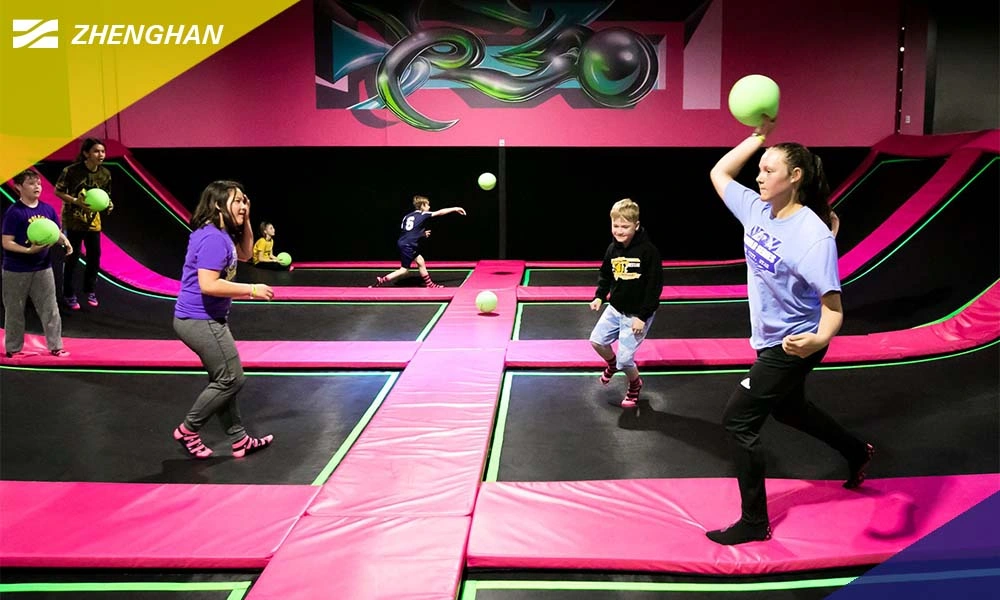
Do not just bolt a basketball hoop to a flat wall; teenagers need dedicated zones to show off and compete, as these are the areas you will sell to corporate team-building events and birthday parties.
For Dodgeball, we install angled trampoline mats right against the side walls using specific high-tension springs, which keeps the mats stiff so players can physically bounce off the walls to dodge a throw. To keep the balls inside, we wrap the whole arena in tightly woven, high-tensile black netting because it absorbs light, allowing your attendants to see right through it and monitor the game without visual obstruction. For the Slam Dunk zones, we reinforce the entire steel frame under the hoop and use longer tumbling-style tracks for the run-up. A grown adult landing in the exact same spot after a dunk creates a massive localized impact that would bend a standard frame, but our reinforced frames handle that shock all day long.
6. The Dedicated Toddler Zone: Protecting Your Revenue
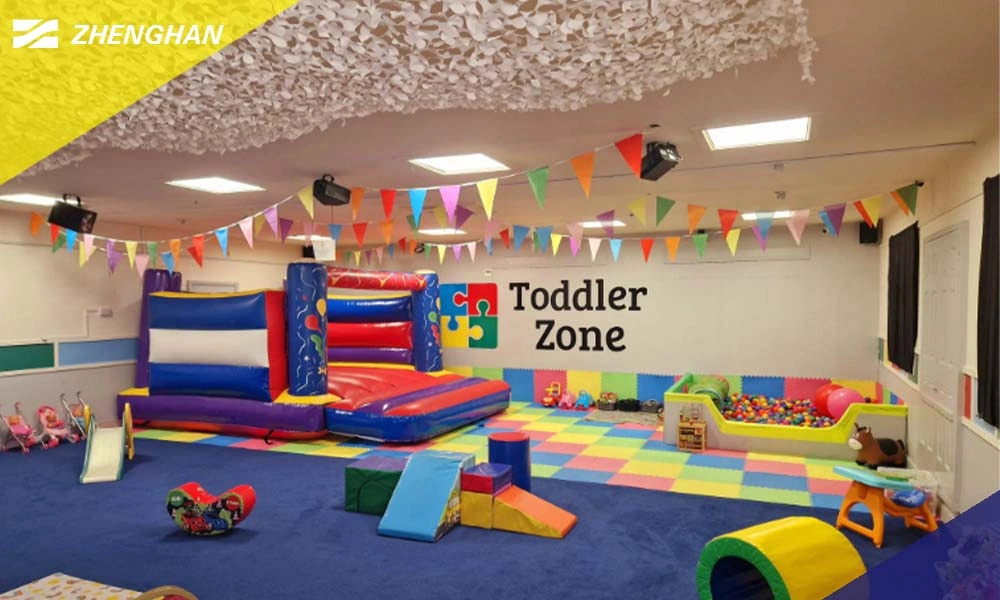
Let me explain how you lose money: if a 3-year-old wanders onto the main court and gets knocked over by a teenager, the mother will grab both kids, demand her money back, and post a negative review online that costs you customers for life.
You must build a dedicated Toddler Zone, and we engineer these differently by using smaller, softer springs so a 30-pound child can actually bounce. We wrap the steel frames in much thicker padding and build the zone with a single, narrow entry gate so parents can stand right there and watch their little ones in peace, safely separated from the flying teenagers.
7. The Battle Beam: High Interaction, Low Cost
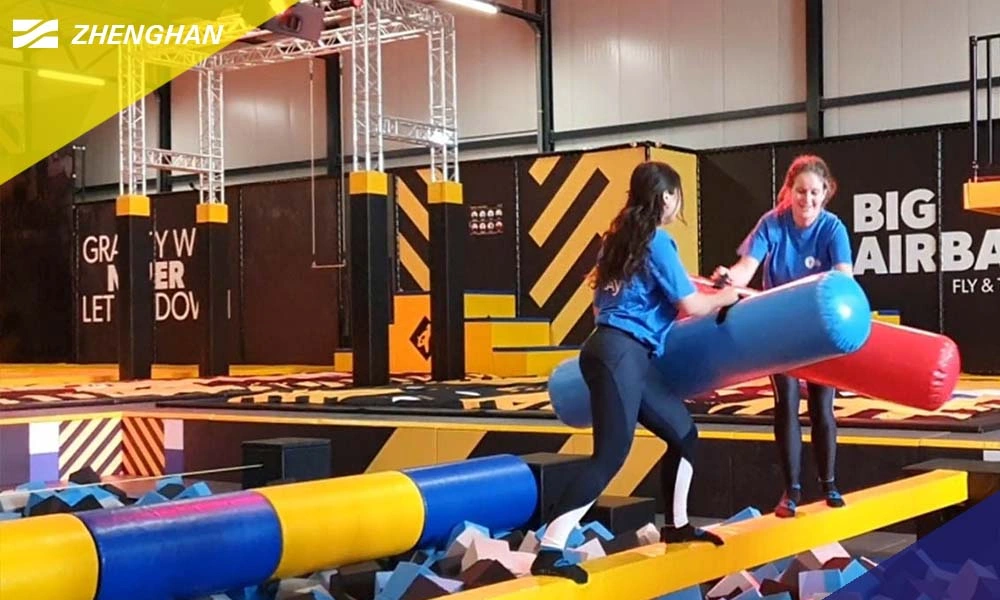
You need attractions that offer huge replay value but cost very little to buy, and the Battle Beam—where two kids stand on a narrow bridge and try to knock each other off with padded sticks—is pure, profitable competition.
We build the core of the beam with reinforced galvanized steel, wrap it heavily in impact-absorbing foam, seal it with Plato PVC to eliminate hard edges, and suspend this directly over your foam pit or airbag. The custom-molded high-density foam jousting sticks are stiff enough to push but soft enough not to bruise, giving you a feature with zero moving parts, zero motors, and zero mechanical maintenance.
Building a park is not about buying toys; it is about building an operational machine. Stick to these proven setups, hold your staff accountable, and your park will make money.
Investor FAQ: Factory Answers on Park Setup
Is galvanized steel strong enough for a commercial ninja course? Yes. Galvanized steel is the absolute industry standard for durability and strength.
My Experience: Having walked hundreds of factory floors, I know that using thick-walled galvanized steel pipes treated with a high-temperature powder coating completely stops rust while handling heavy dynamic loads flawlessly. It gives you the structural integrity you need without wasting your budget on exotic metals.
Are your indoor climbing walls safe for small children? Yes. We rigorously enforce a Double Safety Guarantee system.
My Experience: We don’t trust a single point of failure, so every child wears a secure harness system while climbing directly over a soft buffer pad or a foam pit. If a kid slips, the harness holds them, and the soft landing zone provides immediate secondary protection, which kills the risk and makes parents feel incredibly safe.
Do I have to use airbags, or are foam pits still okay? Yes, foam pits are perfectly fine. Both landing systems work exceptionally well; it just depends on your cleaning crew.
My Experience: Plenty of my highest-revenue clients still buy foam pits because the upfront cost is lower and kids love the feel, provided they enforce a strict weekly cleaning schedule to vacuum dust and swap bad blocks. If you want to cut your cleaning labor to five minutes a night, you upgrade to the airbag—the choice is entirely yours.
How do I prevent the Wipeout sweeper motor from breaking? Only if… Only if you use a heavy-duty motor and actively force your staff to do their job.
My Experience: Wipeout motors only fail when kids treat the spinning arm like a wrestling opponent and the machine is left unattended. We use heavy-duty standard motors, but the real protection is the E-stop control box; if your attendant pays attention and hits stop when kids pile onto the arm, your machine will run without issues for years.
 English
  Spanish
  Arabic